Wireless Technology
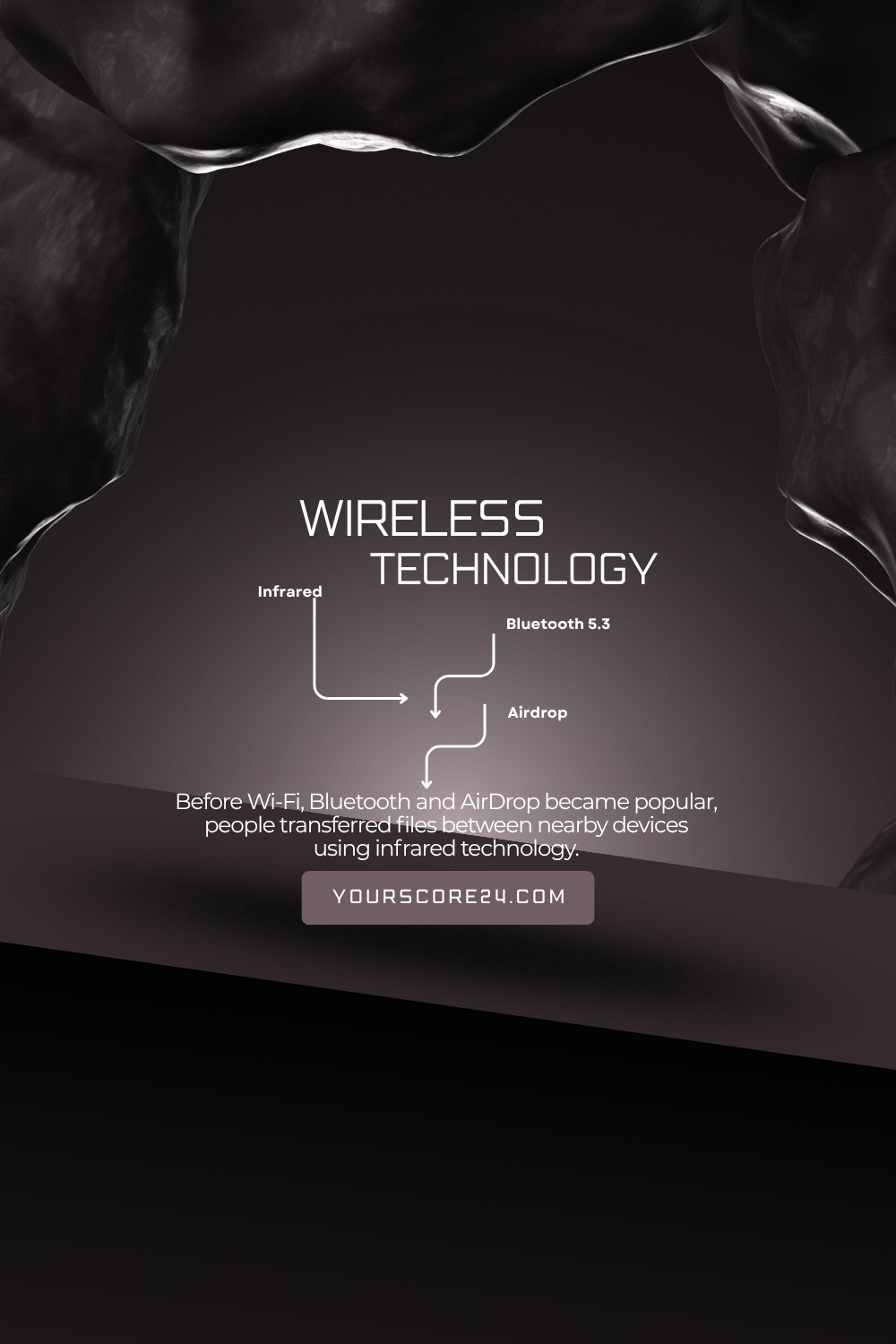
Wireless Technology before Wi-Fi, Bluetooth and AirDrop became popular, people transferred files between nearby devices using infrared technology Infrared, often shortened to IR, is a type of electromagnetic radiation that cannot be seen by the human eye. We experience some infrared radiation as heat. Infrared was discovered in 1800 by British astronomer William Herschel while he was studying the temperature of different colours of sunlight. Therefore, infrared was discovered rather than invented. Over time, scientists and engineers found ways to use infrared signals for communication. It became common in Television remote controls ,Security systems, Medical equipment, Thermal cameras, Early mobile phones, laptops and Wireless file transfers. Many early mobile phones had a small infrared port. To transfer a photograph, contact or document, users had to place the infrared ports of both devices directly opposite each other. The devices needed to remain very close and properly aligned throughout the transfer. Any object blocking the signal could interrupt the connection.This method worked, but it had several limitations:
- The devices required a clear line of sight.
- The transfer speed was relatively slow.
- The devices had to remain close together.
- Moving either device could cancel the transfer.
- Infrared was not suitable for connecting many devices simultaneously. These disadvantages created a need for a more flexible wireless technology.
The advancement of Bluetooth Bluetooth was developed during the 1990s by engineers at the Swedish telecommunications company Ericsson. In 1994, a team that included Dutch engineer Jaap Haartsen and Swedish engineer Sven Mattisson began developing a short-range radio technology that could replace cables between electronic devices.
The technology was named after Harald “Bluetooth” Gormsson, a tenth-century Danish king remembered for uniting different parts of Denmark and Norway. In the same way, Bluetooth was created to unite different electronic devices through a common communication standard.
In 1998, Ericsson, IBM, Intel, Nokia and Toshiba formed the Bluetooth Special Interest Group, which continues to manage and develop Bluetooth standards. Ericsson explains Bluetooth’s early development.
Bluetooth Unlike infrared, Bluetooth uses radio waves, mainly in the 2.4 GHz frequency band. Its signals do not require two devices to face each other directly.
Bluetooth can pass around small objects and work over a greater distance than traditional infrared file sharing. It is now used to connect:
- Smartphones and computers
- Wireless headphones and speakers
- Keyboards and computer mice
- Smartwatches
- Cars and mobile phones
- Medical and fitness devices
- Smart-home appliances
Bluetooth can also transfer files, but it may be relatively slow when sending large videos or documents. This is one reason modern systems sometimes use Bluetooth to find a nearby device before switching to a faster Wi-Fi connection for the actual transfer.
Then AirDrop is Apple’s wireless file-sharing system. It allows users to send photographs, videos, contacts, documents, website links and other content between nearby Apple devices. Apple introduced AirDrop for Mac computers with Mac OS X Lion in 2011. The company described it as a feature that found nearby Macs and automatically created a peer-to-peer wireless connection. AirDrop later became available on the iPhone and iPad with iOS 7 in 2013. See Apple’s original Mac OS X Lion announcement. Bluetooth helps Apple devices discover and identify one another when they are nearby. After the connection is established, AirDrop uses a direct peer-to-peer Wi-Fi connection to transfer the file quickly. This combination provides two important advantages:
- Bluetooth offers efficient nearby-device discovery.
- Wi-Fi provides the speed needed to transfer large files.
AirDrop does not normally require mobile data or an internet connection. However, Wi-Fi and Bluetooth must be enabled because the devices use their wireless hardware to communicate directly. Apple confirms that both technologies should be turned on when using AirDrop. Read Apple’s AirDrop guide. AirDrop transfers are also encrypted, and recipients can normally accept or reject incoming files. Users should keep AirDrop set to Contacts Only or use Everyone for 10 Minutes when sharing with someone who is not saved in their contacts.
However, infrared, Bluetooth and AirDrop are connected through the history of wireless communication. They represent different stages in the effort to exchange information without cables
The journey from infrared to Bluetooth and AirDrop shows how wireless sharing has become faster and more convenient. Infrared allowed early phones to exchange small files, Bluetooth removed the need for direct alignment, and AirDrop now combines Bluetooth and Wi-Fi to provide fast sharing between iPhones, iPads and Macs.
Login to join the conversation
No comments yet. Be the first to comment!